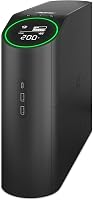
8 Best Battery Backup UPS With Surge Protection (November 2026)
The best battery backup UPS units with surge protection include the CyberPower ST425 Standby UPS Battery Backup for routers and small home offices, the CyberPower CP1500PFCLCD 1500VA Sine Wave UPS for full desktop workstations, and the GOLDENMATE 1000VA/800W Lithium UPS Battery Backup for long battery life.
On this page (8 sections)
- The best battery backup UPS with surge protection for each setup
- How these UPS models compare side by side
- How we compared these battery backup UPS units
- What should you check before buying a UPS with surge protection?
- Which UPS size fits a router versus a desktop?
- Should you pick pure sine wave or simulated sine wave?
- How long will the battery run your gear?
- The verdict: which battery backup UPS with surge protection should you buy?
The best battery backup UPS with surge protection for most homes is the CyberPower ST425, a 425VA standby unit with four battery-backed outlets and four surge-only outlets. It's small enough to tuck beside a router and keeps networking gear running through short outages.
If your load is bigger, the CyberPower CP1500PFCLCD 1500VA gives sine wave output and 12 outlets. The GOLDENMATE 1000VA is the pick when you want a lithium battery that outlasts lead-acid.
A UPS with surge protection does two jobs at once. It clips voltage spikes that arrive through the wall, and it switches to battery when the power drops so your equipment keeps running or shuts down safely.
That combination matters most for gear that stores data or holds a network together.
We compared eight models on outlet counts, watt ratings, output type and battery chemistry. Our score weighs specs, features and buyer feedback against what you're shopping for.
New to these units? Start with what a UPS battery is and how it works, then read how to choose a UPS battery backup before you pick a size.
Our picks at a glance
-
1
 Best for routers and small home offices
CyberPower ST425 Standby UPS Battery Backup
9.3/10 our score
See it on Amazon -
2
 Best for full desktop workstations
CyberPower CP1500PFCLCD 1500VA Sine Wave UPS
9.2/10 our score
See it on Amazon -
3
 Best for long battery life
GOLDENMATE 1000VA/800W Lithium UPS Battery Backup
9.0/10 our score
See it on Amazon
- 4
 Check it
Staples TECH 650VA UPS Battery Backup
Best for a basic desk setup - 5
 Check it
APC Back-UPS Pro BX1500M 1500VA
Best for gaming PCs and whole desks - 6
 Check it
Eaton Tripp Lite AVR550U 550VA UPS 300W
Best for wall mounting - 7
 Best for keeping Wi-Fi aliveCheck it
- 8
 Check it
Vertiv Liebert PowerUPS 100 PST6-1100LVMT
Best for retail counters
The best battery backup UPS with surge protection for each setup
The ST425 wins on value and fit for a typical home office, while the larger units cover bigger loads and the lithium model targets long-term cost. Choose by what you need to keep running, not by raw capacity alone.
CyberPower ST425 Standby UPS Battery Backup: Best for routers and small home offices
- 425VA/260W simulated sine wave output
- 8 NEMA 5-15R outlets
- LED status and wiring fault light
- 3-year warranty including the battery
A small standby unit that keeps a router, modem and desktop running through short outages and adds surge protection on every outlet.
Pros
- Compact 8.3 in wide body
- Battery covered by the 3-year warranty
- Transformer-spaced outlets for bulky plugs
Cons
- 260W limits what you can plug in
- Simulated sine wave output
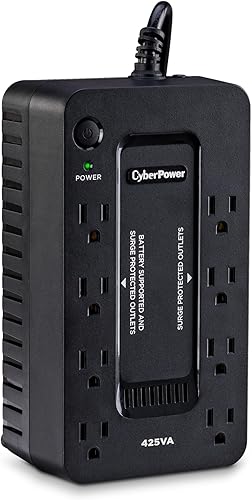
This is the unit to buy first for a router, modem and a small desktop. CyberPower rates it at 425VA/260W, which covers networking gear and light office electronics without spending on capacity you won't use.
Four of its eight outlets carry battery backup and surge protection, and the other four carry surge protection only. That split lets you put the essentials on battery and park a printer or speakers on the surge side.
Transformer-spaced outlets make room for bulky adapters.
An LED light shows power-on and wiring fault status, so you can spot a bad outlet before an outage catches you. The compact 8.3 in wide body sits behind a desk or on a shelf.
The trade-off is the 260W ceiling and simulated sine wave output. If you run a gaming PC with an active PFC supply, move up to the CP1500PFCLCD.
For a typical router and monitor setup, this is the one to get. It also carries a 3-year warranty that includes the battery and a 75,000 USD connected equipment guarantee.
CyberPower CP1500PFCLCD 1500VA Sine Wave UPS: Best for full desktop workstations
- 1500VA/1000W sine wave output
- 12 outlets plus USB-A and USB-C
- Automatic voltage regulation
- Color LCD panel that tilts up to 22 degrees
Sine wave power and a high watt rating suit active PFC power supplies in gaming rigs and workstations, with a display that shows what the unit is doing.
Pros
- Pure sine wave output for PFC supplies
- USB-C and USB-A charging ports
- Automatic voltage regulation
Cons
- Heavy at 24.9 lb
- Needs more desk or floor space
Choose this when your desk has real power draw. At 1500VA/1000W it runs a full workstation or gaming PC with monitors, and its sine wave output matches what active PFC power supplies expect.
That avoids the shutdowns some supplies hit on simulated sine wave units.
Six battery-backed outlets and six surge-only outlets give you room for a whole desk. Two USB ports, one Type-A and one Type-C, charge a phone or tablet even when the wall power is out.
A color LCD shows load, battery and input status, and the screen tilts up to 22 degrees so you can read it when the unit sits under the desk.
Automatic voltage regulation corrects small sags and surges without switching to battery, which saves the battery for a true outage. That matters in areas with frequent brownouts.
The downside is its 24.9 lb weight and mini-tower footprint. It isn't a unit you hide behind a router.
For a light load, the ST425 does the same basic job for less bulk. For a workstation, this is the better fit.
For even longer battery life, see our guide to the best lithium UPS battery backups.
GOLDENMATE 1000VA/800W Lithium UPS Battery Backup: Best for long battery life
- 1000VA/800W pure sine wave output
- LiFePO4 battery rated for more than 5000 cycles
- 8 outlets with battery backup and surge protection
- LCD panel with buzzer mute
A lithium unit that cuts replacement battery costs over its life and gives a home office pure sine wave power in a tower body.
Pros
- More than 5000 charge cycles
- Pure sine wave output
- Buzzer mute button
Cons
- 10-hour recharge time
- Supports 90–140V AC input only
The GOLDENMATE 1000VA suits a buyer who wants to set the unit and forget it. Its LiFePO4 battery is rated for more than 5000 charge cycles and a lifespan of over 10 years, so you skip the battery swaps that lead-acid units need every few years.
All eight outlets carry battery backup and surge protection, and the output is pure sine wave at 1000VA/800W. That's enough for a home office tower, network gear or telecom equipment.
The LCD panel shows battery and power conditions, and a single touch on the switch mutes the alarm when the unit goes to battery.
The lithium chemistry is the real difference against the lead-acid models here. A longer service life means fewer replacements and less downtime.
Its 10-hour recharge time is longer than the lead-acid units, so plan for a full recharge after a long outage.
It supports 90–140V AC input, so confirm your outlet voltage before you plug it in. For a standard 120V home circuit that's fine.
If you want pure sine wave without the lithium price, the CP1500PFCLCD covers that. If long battery life is your goal, this is the pick.
Read more about how to choose a UPS battery backup for sizing help.
Staples TECH 650VA UPS Battery Backup: Best for a basic desk setup
- 650VA/360W capacity
- 8 outlets
- Built-in surge protection
- Compact footprint
A simple standby UPS for a desktop, modem and a few peripherals, with a short body that fits under a desk.
Pros
- Fits under most desks
- Supports desktops and modems
- Eight total outlets
Cons
- 360W suits light loads only
- No display
The Staples TECH 650VA fits a basic desk without taking over the floor. At 650VA/360W it supports a desktop, a modem and essential peripherals, and its compact body slides under a workstation.
It spreads eight outlets across battery-backed and surge-only connections, so you can decide what gets runtime and what only needs spike protection. Built-in surge protection covers voltage spikes on everything plugged in.
This is the no-frills option. There's no display and no software shutdown support, so you won't get a graceful system shutdown when the battery runs low.
It's for the reader who wants backup for a simple setup and doesn't need to monitor load or battery state.
Against the ST425, it offers more watt headroom (360W against 260W) but less brand detail on runtime. Against the BE600M1, it adds outlets but drops the USB charging port.
Pick it for a plain desktop and modem, and move up if you need shutdown software or a display. If you're still deciding what type of unit fits, our overview of the best UPS battery backup options lays out the categories.
APC Back-UPS Pro BX1500M 1500VA: Best for gaming PCs and whole desks
- 1500VA/900W with automatic voltage regulation
- 10 outlets
- Coaxial and Ethernet surge protection
- LCD status display
A high-capacity line-interactive unit that handles brownouts without draining the battery and adds data-line surge protection.
Pros
- Five battery-backed outlets
- AVR corrects brownouts
- User-replaceable battery
Cons
- Battery sold separately
- Tall 15 in tower body
The APC BX1500M is built for a whole desk, gaming rig included. At 1500VA/900W it runs a gaming PC with an active PFC supply, and its automatic voltage regulation corrects brownouts from 88V and surges of +/-13% without draining the battery.
Five outlets carry battery backup and five are surge only, and the unit adds coaxial and Ethernet surge protection for network and cable lines. Among the higher-capacity picks here, it is one of the few that also covers coaxial and Ethernet lines.
An LCD shows battery charge, estimated runtime, load and input voltage.
Runtime is rated at 68 minutes at 100W. Its 15 in tall tower needs floor or low-shelf space, and the replacement battery is sold separately, so a future swap costs extra.
Against the CP1500PFCLCD, it has fewer battery-backed outlets (five against six) and no USB charging ports, but it brings data-line surge protection and a slightly lower price tier. Choose it for a gaming PC or a desk with a network connection you want shielded.
For a smaller desk, the BE600M1 covers the basics.
Eaton Tripp Lite AVR550U 550VA UPS 300W: Best for wall mounting
- 550VA/300W with AVR
- 8 outlets
- Bottom keyhole mounting tabs
- USB port and PowerAlert software
A compact unit that can hang on a wall and shut down a computer safely through its USB port and PowerAlert software.
Pros
- Wall-mount keyhole tabs
- Unattended shutdown support
- 316 joules of surge protection
Cons
- 300W is modest
- Wall mounting needs a solid surface
The Eaton Tripp Lite AVR550U suits a spot where floor space is tight. It has bottom keyhole mounting tabs, so you can hang it on a wall near the gear it protects.
At 550VA/300W it keeps an energy-efficient desktop and small monitor running for about 32 minutes, according to Tripp Lite. Four outlets carry battery backup and four carry surge protection only, with wide spacing for bulky plugs.
AVR corrects input from 89V to 145V back to 120V.
The USB port and included cable work with PowerAlert software to save files and shut the system down during a long outage. That's a real advantage over the ST425, which has no shutdown software.
It also protects a phone or Ethernet line through its RJ45 port.
The trade-off is the 300W rating, which limits you to lighter loads. Against the Staples TECH 650VA it offers less wattage but adds software shutdown and wall mounting.
Pick it for a wall-mounted home office or a small point-of-sale station.
APC Back-UPS BE600M1 600VA: Best for keeping Wi-Fi alive
- 600VA/330W capacity
- 7 outlets
- 1.5A USB charging port
- 23 minutes at 100W
A compact router and modem protector with a USB port that keeps a phone charging during an outage.
Pros
- USB charging during outages
- Easy battery replacement
- Well-spaced outlets
Cons
- Only two surge-only outlets
- No display
The APC BE600M1 is the pick when your main worry is losing Wi-Fi. At 600VA/330W it runs a router and modem for about 23 minutes at 100W, long enough to ride out most short outages and keep the network up.
Five outlets carry battery backup and two are surge only, all well spaced. A 1.5A USB port keeps a phone charging during an outage, which is handy when the power is out and you need to stay reachable.
An audible alarm and LED indicators tell you when the unit is on battery.
The battery is user-replaceable, so you can swap it when it ages without buying a new unit. That's a cost saver against sealed designs.
The trade-off is modest capacity and no display or shutdown software. For a router and modem alone, it's a strong fit.
If you also need to run a desktop through an outage, the ST425's status light and wider outlet spread may serve you better. Pick this one for network uptime first.
Vertiv Liebert PowerUPS 100 PST6-1100LVMT: Best for retail counters
- 1100VA/670W standby output
- 8 outlets
- USB-A and USB-C charging
- Alarm mute button
A standby unit aimed at point-of-sale systems and small networks, with user-replaceable batteries and a mute button.
Pros
- USB-C and USB-A ports
- User-replaceable battery
- Alarm mute function
Cons
- Simulated sine wave output
- Lowest score in this group
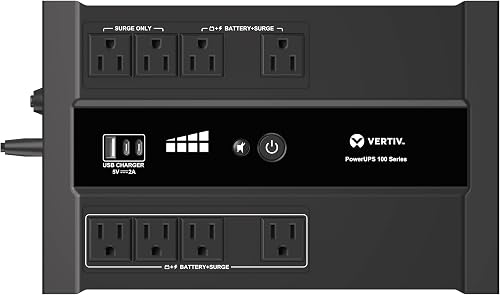
The Vertiv Liebert PowerUPS 100 targets small retail and office setups. At 1100VA/670W it covers a point-of-sale terminal, a network switch or a small desktop cluster, and its 500-joule surge rating handles spikes on the line.
Six outlets carry battery backup and two are surge only, and USB-A and USB-C ports charge portable devices. The battery is user-replaceable and hot-swappable, so maintenance doesn't take the unit offline.
An alarm mute button quiets the beeps once you've handled an issue.
It uses simulated sine wave output, which suits standard power supplies but not every active PFC desktop. The 670W rating sits between the ST425 and the CP1500PFCLCD.
Its lowest score here reflects the narrower fit: it's built for counter and small-network duty, not a gaming desk.
Choose it for a shop counter or a small office where uptime matters and you want a mute button and easy battery access. For a home workstation, the CP1500PFCLCD is the better match.
For wall mounting, the AVR550U wins.
How these UPS models compare side by side
Capacity and outlet count matter most, but output type and battery chemistry decide which unit suits sensitive electronics. The table lines up the eight picks on the specs that change the buying decision.
| Product | Best for | Capacity | Outlets | Weight | Our score |
|---|---|---|---|---|---|
| CyberPower ST425 Standby UPS Battery Backup | routers and small home offices | 425VA/260W | 4 battery backup, 4 surge only | 3.8 lb | 9.3 |
| CyberPower CP1500PFCLCD 1500VA Sine Wave UPS | full desktop workstations | 1500VA/1000W | 6 battery backup, 6 surge only | 24.9 lb | 9.2 |
| GOLDENMATE 1000VA/800W Lithium UPS Battery Backup | long battery life | 1000VA/800W | 8 battery backup and surge | 9.0 | |
| Staples TECH 650VA UPS Battery Backup | a basic desk setup | 650VA/360W | 8 total, battery and surge | 8.9 | |
| APC Back-UPS Pro BX1500M 1500VA | gaming PCs and whole desks | 1500VA/900W | 5 battery backup, 5 surge only | 8.8 | |
| Eaton Tripp Lite AVR550U 550VA UPS 300W | wall mounting | 550VA/300W | 4 battery backup, 4 surge only | 8.6 | |
| APC Back-UPS BE600M1 600VA | keeping Wi-Fi alive | 600VA/330W | 5 battery backup, 2 surge only | 8.5 | |
| Vertiv Liebert PowerUPS 100 PST6-1100LVMT | retail counters | 1100VA/670W | 6 battery backup, 2 surge only | 7.1 |
How we compared these battery backup UPS units
We checked each model's stated capacity, outlet split, output waveform and battery type, then weighed how those specs fit common home setups. Scores reflect that fit against what a typical buyer needs from a battery backup ups with surge protection.
Outlet counts matter more than they look. A unit with six battery-backed outlets runs a full desk, while one with four covers the essentials and leaves the rest on surge protection.
We tracked the split for every model.
Runtime figures came from the maker's stated ratings at set loads. Those numbers change with what you plug in, so we treated them as a guide to relative endurance rather than a guarantee.
What should you check before buying a UPS with surge protection?
Start with the watt rating of what you need to keep running. Add up the watts on the devices you want backed up, then choose a unit with headroom above that total.
A router and modem draw little, while a gaming PC with a monitor can pull several hundred watts.
Match the output type to your power supply. Modern active PFC supplies work best on pure sine wave units like the CP1500PFCLCD or GOLDENMATE.
Standard supplies run fine on simulated sine wave models like the ST425 or AVR550U.
How many battery-backed outlets do you need?
Count the devices you can't afford to lose. Put the router, modem, desktop and monitor on battery-backed outlets, and park printers and speakers on surge-only ones.
A five-outlet split like the BE600M1 or BX1500M covers a small desk, while six or more suits a workstation.
Does automatic voltage regulation matter?
Yes, in areas with brownouts or frequent sags. AVR corrects low and high voltage without switching to battery, so the battery stays charged for a real outage.
The BX1500M, AVR550U and CP1500PFCLCD all include AVR.
Lead-acid or lithium: which battery should you pick?
Lead-acid is the standard and costs less up front, but it typically lasts about 3 years. Lithium iron phosphate lasts far longer and handles more charge cycles.
If you plan to keep the unit for a decade, the GOLDENMATE's lithium pack is the lower long-term cost.
Which UPS size fits a router versus a desktop?
A router and modem setup runs on a 300 to 425VA unit. Add a desktop and monitor and you move into 550VA to 650VA territory.
A gaming PC or a multi-monitor workstation calls for 1000VA or more.
The ST425 covers networking gear, the AVR550U and BE600M1 handle a light desktop, and the CP1500PFCLCD and BX1500M serve full workstations. The GOLDENMATE sits in between with 800W and a lithium battery.
Should you pick pure sine wave or simulated sine wave?
Pick pure sine wave for active PFC power supplies, which most modern desktops and gaming PCs use. Simulated sine wave units are fine for routers, modems, standard desktops and networking gear.
The CP1500PFCLCD and GOLDENMATE deliver pure sine wave, while the ST425, AVR550U, BX1500M and Vertiv use simulated output. If your PC has a high-efficiency PFC supply, choose sine wave to avoid shutdowns during a switchover.
How long will the battery run your gear?
Runtime shrinks as the load grows. A light router load can last well over an hour on a 600VA unit, while a full desktop drains the same battery in minutes.
The BX1500M rates 68 minutes at 100W, the BE600M1 rates 23 minutes at 100W, and Tripp Lite rates the AVR550U at 32 minutes for an efficient desktop and small monitor.
The verdict: which battery backup UPS with surge protection should you buy?
The CyberPower ST425 is the best pick overall for most homes. It pairs four battery-backed outlets with four surge-only ones, adds a status light and wiring fault indicator, and fits beside a router without eating desk space.
Buy the CP1500PFCLCD if you run a workstation or gaming PC that needs sine wave power. Choose the GOLDENMATE 1000VA when long battery life and fewer replacements matter most.
For a router-only setup, the BE600M1 keeps Wi-Fi alive with a USB charging port. For a wall-mounted office, the AVR550U is the practical choice.
If you're still weighing battery types and replacement costs, read the best UPS battery backup guide and our lithium UPS roundup before you order.
Our top 3 picks at a glance
-
1
Best for routers and small home offices
CyberPower ST425 Standby UPS Battery Backup
9.3/10 our score
See it on Amazon -
2
Best for full desktop workstations
CyberPower CP1500PFCLCD 1500VA Sine Wave UPS
9.2/10 our score
See it on Amazon -
3
Best for long battery life
GOLDENMATE 1000VA/800W Lithium UPS Battery Backup
9.0/10 our score
See it on Amazon
Frequently asked questions
Do I need a UPS with surge protection or just a surge protector?
You need both. A surge protector only blocks voltage spikes, while a UPS adds a battery that keeps devices running when the power fails.
Every model here combines the two, so plugged-in gear gets spike protection and short-outage backup from one unit.
How many outlets on a UPS actually run on battery?
Only the battery-backed outlets keep devices running during an outage. Most units split their outlets between battery backup and surge-only, so check the count before you buy.
The ST425, for example, has four of each, while the CP1500PFCLCD offers six of each.
What size battery backup UPS do I need for a home router and modem?
A 300 to 425VA unit covers a router and modem. The CyberPower ST425 at 425VA/260W is enough for networking gear, and the APC BE600M1 at 600VA/330W gives extra headroom.
Add a desktop or monitor and step up to 550VA or more.
Is pure sine wave better for computers?
Yes, for modern active PFC power supplies. Sine wave output matches utility power closely and avoids shutdowns some PFC supplies suffer on simulated sine wave units.
The CP1500PFCLCD and GOLDENMATE models deliver pure sine wave, while the ST425 and AVR550U use simulated sine wave.
How long does a UPS battery last during an outage?
Runtime depends on load. APC rates the BE600M1 at 23 minutes at 100W and the BX1500M at 68 minutes at 100W.
Tripp Lite says the AVR550U keeps an energy-efficient desktop and small monitor running for 32 minutes.
Heavier loads shorten those times.
How often do UPS batteries need replacing?
Lead-acid batteries typically last about 3 years. Lithium iron phosphate packs, like the one in the GOLDENMATE 1000VA, are rated for more than 5000 charge cycles and a lifespan of over 10 years.
User-replaceable designs let you swap the battery without replacing the whole unit.